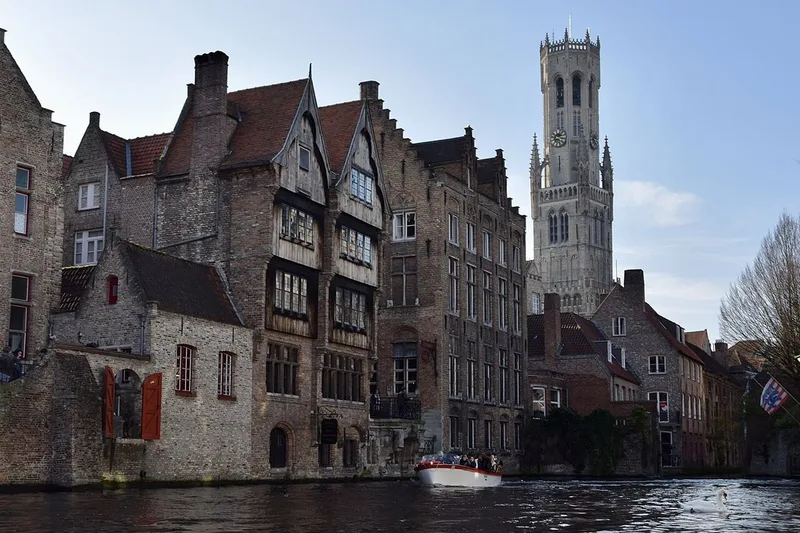
Bruges in 2 days suits travellers who want a compact medieval centre, a tower to climb and canal-side walks without a crowded timetable. Brugge, as it is written locally, is small enough to cross on foot, so the plan is built around timing. The Rozenhoedkaai and the Beguinage are calm early and late, while the Markt fills once day visitors arrive. UNESCO protects the whole historic centre for its brick Gothic architecture and the Flemish Primitives who worked here. Day 1 covers the squares, the Belfry and the water. Day 2 turns to the quiet south and then leans on Ghent.
Quick facts
- Country and region: Belgium, in Flanders, inland from the North Sea coast.
- Main airport: Brussels Airport (BRU), with a direct hourly train to Bruges.
- Main station: Brugge (Bruges), about a 20-minute walk from the Markt.
- Getting around: on foot, with city buses 1 and 2 and hire bikes as backups.
- Currency: euro (EUR).
- Language: Dutch.
- Time zone: Central European Time, with summer time.
- Best months: April to June and September to October.
Best time to visit
Spring and early autumn give mild walking weather and thinner crowds than midsummer. Canal boats are guaranteed daily from March through October and run on a rotation from November to February, according to Visit Bruges. The Procession of the Holy Blood, which UNESCO recognised as intangible heritage in 2009, takes place on Ascension Day; the next is on 6 May 2027, so expect closed streets and full hotels. Summer carillon concerts at the Belfry run from June to September. Winter has short days, yet the Winter Glow programme is scheduled from 20 November 2026 to 31 January 2027. Check the official calendar for event dates.
Getting there and around
From Brussels Airport a direct train runs to Bruges every hour, according to Visit Bruges. Other airport trains call at Brussels-North, Central or South, where you change to one of three trains an hour for Bruges; the ride from Brussels-South takes about an hour. Belgian Railways (NMBS/SNCB) runs direct trains from Antwerp, Ghent, Leuven and Brussels, and Eurostar services from London, Paris and Amsterdam arrive at Brussels-South first. Brussels in 2 days is the natural stop for a change of trains.
From the station, the Markt is a 20-minute walk past several sights. De Lijn buses 1 and 2 also run to the centre, every five minutes according to the city. Almost every street in the centre is a bicycle zone with a 30 km/h limit. Inside the ring of canals, the Markt, the Burg, the Rozenhoedkaai and the Church of Our Lady are all within a few minutes of each other.
Where to stay
Around the Markt and the Burg you wake up beside the main sights, and the lanes are empty at first light. The price is crowds from late morning and a carillon that plays every quarter of an hour. This area suits a first short stay or a trip built around dawn walks.
Near the station and 't Zand square, you have the bus hub, the Concertgebouw and underground car parks. The Markt is about a 10-minute walk from 't Zand, which suits early trains to Ghent or the coast.
The southern edge around the Beguinage and the Minnewater park is the quietest choice. The station is close, the Church of Our Lady is a short walk north, and the evening canals are almost empty.
Day 1: The Markt, the Burg and the canals
Morning: Rozenhoedkaai, Burg and Belfry
Be at the Rozenhoedkaai early. Visit Bruges calls it the most popular spot for photography in the city, and from the quay the canal leads the eye to the Belfry. Walk along the Dijver, then up to the Burg, a square lined with the Gothic City Hall (1376 to 1421) and the Basilica of the Holy Blood, whose Romanesque lower chapel is free to enter.
Then take the short walk to the Markt and climb the Belfry. The tower is 83 metres high, leans about a metre and has 366 steps with no lift. Book a time slot in advance; the official Belfry page says the quietest times are shortly after opening and near closing. Allow about an hour for the climb. On Wednesday, Saturday and Sunday from 11:00 to noon the city carillonneur plays.
Afternoon: Church of Our Lady and the Flemish Primitives
Walk south along Mariastraat to the Church of Our Lady, whose 115-metre brick tower is the second highest in the world. The museum section holds Michelangelo's Madonna and Child and the tombs of Mary of Burgundy and Charles the Bold. Across the street, the Museum Sint-Janshospitaal shows seven works by Hans Memling, including the Ursula shrine, in a hospital building that Visit Bruges counts among Europe's oldest. If you prefer paintings, the Groeninge Museum on the Dijver has Jan van Eyck's Madonna with Canon Joris van der Paele.
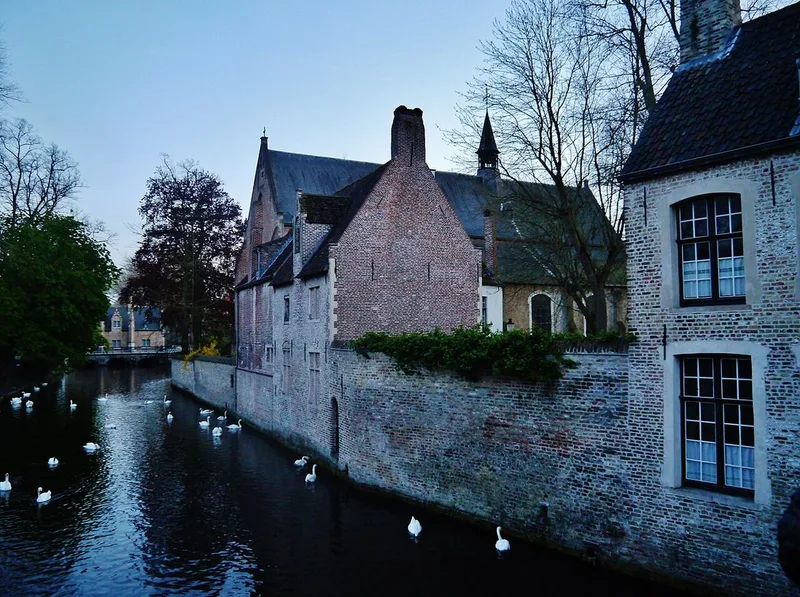
Finish with the canal boat, a 30-minute loop from five landing stages that passes the Beguinage gate. About a hundred swans live on the canals.
Evening: chocolate and the quiet streets
Choco-Story, the chocolate museum near Jan van Eyckplein, follows cocoa from the Maya to today across four floors. For shop chocolate, Visit Bruges lists The Chocolate Line, where Dominique Persoone works and his son Julius opened the Julius Chocolate Bar in July 2025, and Dumon, with shops on Walstraat, Eiermarkt and Mariastraat. Finish on the Groenerei, which the city calls the loveliest of its canals.
Day 2: The quiet south and Ghent
Morning: Beguinage and Minnewater
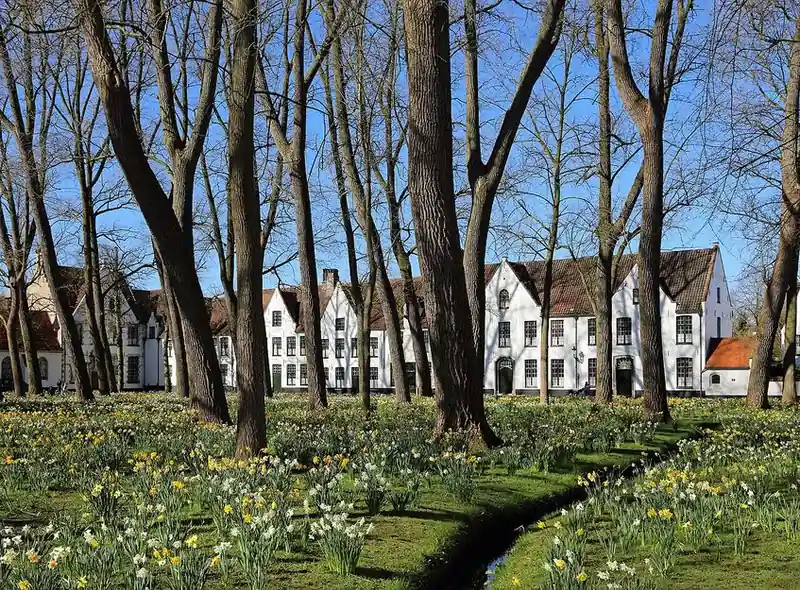
Walk to the Begijnhof before the first groups. The Princely Beguinage Ten Wijngaerde was founded in 1245, and women still live in the white houses around the convent garden. The city asks visitors for silence, and entry is free. UNESCO recognised it in 1998 as one of 13 Flemish béguinages. The beguines were unmarried or widowed women who lived a religious life without retreating from the world, according to UNESCO. Beside it, the Bakkersrei is the only place in the centre where the swans are fed, so the water is busy with birds.
A short stroll takes you to the Minnewater, the so-called Lake of Love, and its bridge, with the round Gunpowder Tower on the ramparts nearby. From here the station is close, which suits the Ghent train.
Afternoon: Ghent by train
Direct trains reach Ghent Sint-Pieters in about 30 minutes, and tram 1 runs from the station to the centre every ten minutes, says Visit Bruges. In Ghent, see the Ghent Altarpiece by the Van Eyck brothers in St Bavo's Cathedral. The visitors' centre sells timed tickets online, and a restoration programme is listed until 31 December 2026, so check what is on show. Then walk to the Graslei and Korenlei on the Scheldt, the Gravensteen castle and the Patershol district, where narrow streets run in the castle's shadow. Ghent residents are nicknamed noose wearers after a punishment from Emperor Charles, a name they wear with pride. The S.M.A.K., Design Museum, MSK and STAM are options if the weather turns.
Evening: back in Bruges
Return in the late afternoon, or linger in Ghent until the Light Plan switches on the lighting of its buildings and squares. In Bruges, the Markt is easier to enjoy after the groups have left. Listen for the Belfry's automatic melody every 15 minutes, then eat in the lanes around the Burg. Allow time for the last train back and check times on the Belgian Railways planner.
If it rains, on a budget, with kids
If it rains
Sint-Janshospitaal, Groeninge, the Church of Our Lady museum, City Hall and Choco-Story are all indoors. The Belfry can close in heavy rain or strong wind, and ticket holders then receive a voucher.
On a budget
The Markt, the Burg, the Rozenhoedkaai, the Beguinage, the Minnewater and the Basilica of the Holy Blood cost nothing, although the basilica treasury needs a ticket. The Church of Our Lady itself is free; only its museum charges. For three or more municipal museums, the Musea Brugge Card gives access over 72 hours, and museumPASSmusées holders are also covered.
With kids
The Belfry has no minimum age, but children under 12 must be accompanied. The boat, the swans and Choco-Story suit younger children. Sint-Janshospitaal is free up to age 12, and its Closer to Memling room is interactive.
Day trip or a third day
Damme
Damme was the transhipment port of Bruges. Reach it by bike along the poplar-lined Damse Vaart, or on the paddle steamer Lamme Goedzak, which sails four times a day from Noorweegse Kaai. Visit the 15th-century town hall and climb the church tower. The Uilenspiegel Museum there covers the legendary Tijl Uilenspiegel.
The coast
Trains from Bruges end at Ostend, Blankenberge or Knokke. Ostend is about 15 minutes away, according to Visit Bruges. Zeebrugge has the broadest beach on the Belgian coast, and the Boudewijn Canal links it to the old city. Check the Belgian Railways planner for times to Blankenberge and Knokke.
Antwerp
Direct trains from Antwerp run one to four times an hour. The journey time varies, so check the Belgian Railways planner, then follow Antwerp in 2 days for the Flemish port city.
Practical tips
Book a Belfry time slot online, even with a Musea Brugge Card. Bags larger than 34 by 22 cm and umbrellas go in the free Belfry lockers, and dogs are not allowed in the tower. Boat tickets are sold at the landing stage only. In the Beguinage, keep voices low, as the city asks.
The Groeninge Museum closes on 11 January 2027 for a four-year refurbishment, and its core collection moves to the BRUSK gallery from March 2027, according to the museum page.
Cobbles are common, and the Belfry cannot be visited in a wheelchair. The City Halls courtyard is accessible, and a tactile model with Braille text stands on the Markt. See the Visit Bruges accessibility page for a downloadable guide.
Frequently asked questions
Is the Belfry safe to climb if it leans?
Yes. The tower leans about one metre towards the south-east, probably because it stands on a former floodplain, and a 3D scan was made in 2017. Visit Bruges states that it is safe to climb.
Where is Michelangelo's statue in Bruges?
The white marble Madonna and Child stands in the Church of Our Lady. It is described as the only Michelangelo work to leave Italy in his lifetime, bought by the Mouscron merchant family. It sits in the museum section, so a museum ticket is needed.
Do I need to book the canal boats?
No. Individual visitors cannot reserve in advance; tickets are sold at the five jetties. All companies use the same route between Jan van Eyckplein and the Beguinage and charge the same fare. The tour lasts 30 minutes without stops, so you cannot hop off.
Why does Bruges have so many swans?
A popular legend says Maximilian of Austria ordered the swans after the execution of Pieter Lanchals in 1488. A swan appears on Lanchals' funerary monument in the Church of Our Lady. Today City of Bruges staff look after the swans, and in winter they move to a covered shelter.
More city guides
- Brussels in 2 days: the capital, about an hour away.
- Antwerp in 2 days: a port city with direct trains.
- Amsterdam in 2 days: a canal city to the north.
- Paris in 2 days: reached via Brussels by high-speed train.