The pad is for warmth first, comfort second
Most people shop for a sleeping pad the way they shop for a mattress: thick, soft, comfortable. That instinct is understandable but it misses the main job. The open encyclopedia entry on sleeping pads puts it plainly: the primary purpose of the pad is to stop body heat draining into the ground while you sleep. Your sleeping bag compresses under your weight, so underneath you it insulates very little. The pad has to do that work.
This guide is about picking a pad for hiking and trekking trips where you carry everything yourself. This is not a product test or a brand ranking. We explain the three constructions, how to read the warmth rating, and which trade-offs actually matter on a trail. Where we cite a source it is open or a standards body, read on 16 October 2026.
Three constructions, three personalities
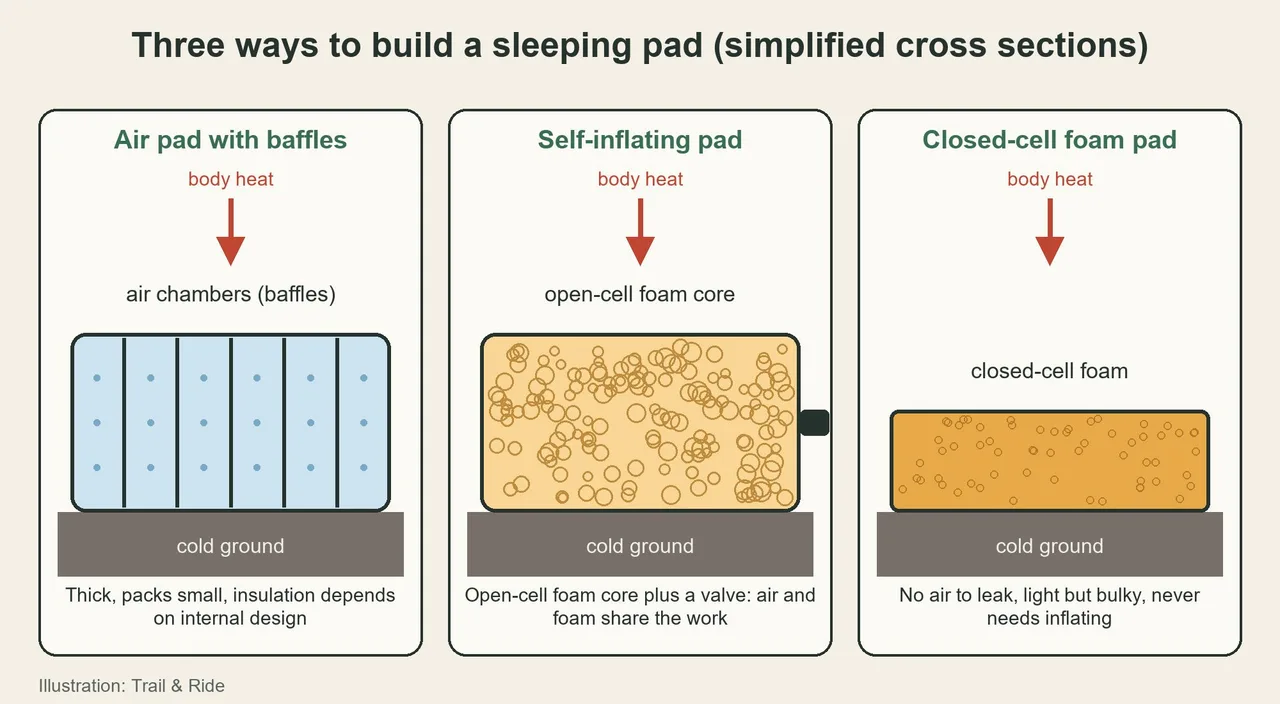
Air pads (manually inflated) are chambers of air, often split into baffles. They give good thickness and a lot of comfort for little weight and a small packed size. The catch is convection: moving air inside a plain chamber carries heat away, which reduces insulation. Better designs partition the cavities or fill them with insulation to limit that movement.
Self-inflating pads have an open-cell foam core and a valve. The foam draws air in and does part of the insulating. For many years the design was protected by patents, but since they expired many makers sell them. They are lightweight and pack to a small size, which is why they are popular with hikers and campers.
Closed-cell foam pads need no inflation. The entry on sleeping pads notes they are lighter and more durable than self-inflating pads because they have fewer parts and cannot be punctured. They are usually thinner, so less comfortable, and they take more room on or in a pack. Open-cell foam without a sealed skin is rarely used outdoors because it absorbs water like a sponge.
R-value without the confusion
R-value measures thermal resistance: the higher the number, the better the pad resists heat flow. For camping mattresses there is a standard test, ASTM F3340-18, which measures thermal resistance between a heated plate and a cold plate under constant compression. ASTM itself points out that the result is a repeatable comparison, but real life can differ because of edge heat loss, uncovered surface loss and how you move in the night. So treat the number as a way to compare pads, not as a promise of temperature comfort.
Three practical points follow from the sources:
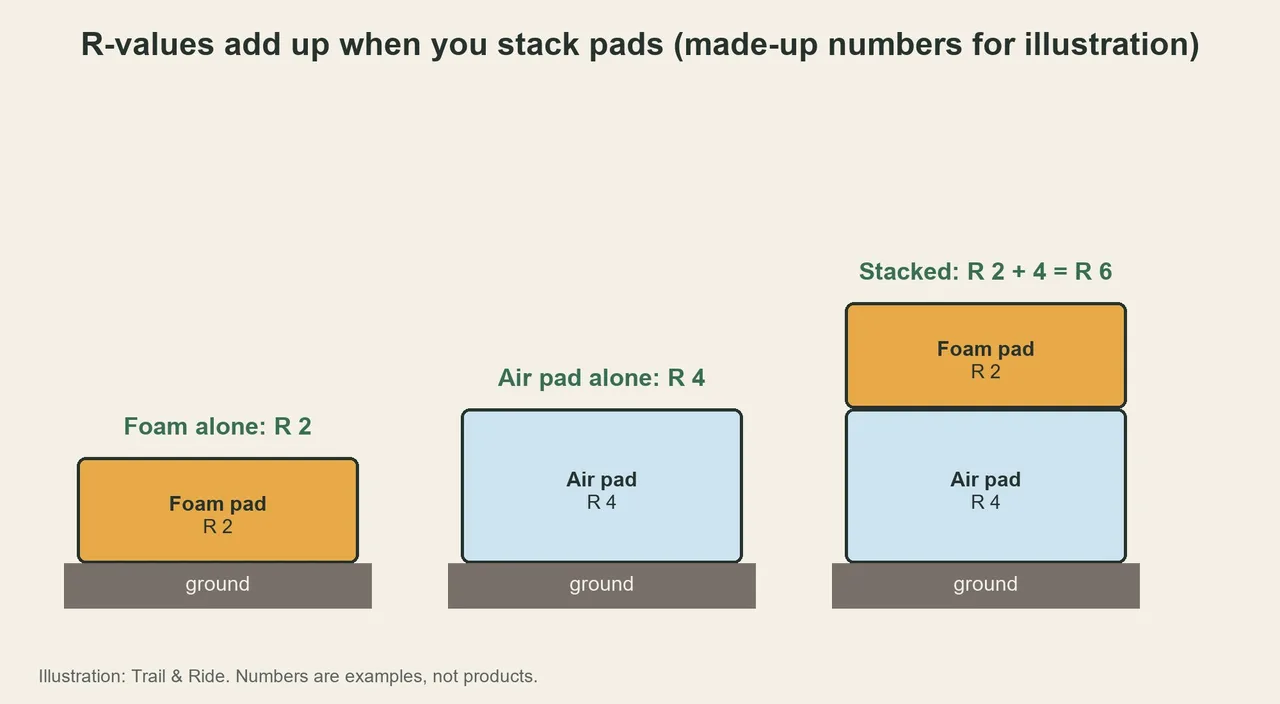
- R-values add up. The open encyclopedia entry on R-value states that values are additive for multiple layers. A thin foam pad under an air pad raises the total, which is why many cold-weather sleepers stack. Our sketch below uses made-up numbers to show the idea, not real products.
- Check the scale. R-values quoted in US customary units are about 5.68 times larger than the same value in metric (RSI). Compare two pads only if both numbers use the same scale.
- Pads do not have a simple warmth label like sleeping bags. Sleeping bags have the EN 13537 test and widely accepted recommendations, while pads lack an equally simple mapping for "how much warmth to expect". The same source says pad R-values range from about 1 to more than 10.
The ground matters as much as the number
Heat leaves faster into some ground than others. Highly conductive surfaces such as concrete and granite need more insulation for the same temperature than insulating surfaces such as snow, dry moss, loose soil or wood. The way you sleep matters too: more heat is lost downward when you lie on your stomach than on your side. Pad and bag work as a system. A warmer bag can partly make up for a thin pad, and a thick pad can rescue a bag rated for milder nights, but your cost, weight and comfort trade-offs will often leave one of the two short.
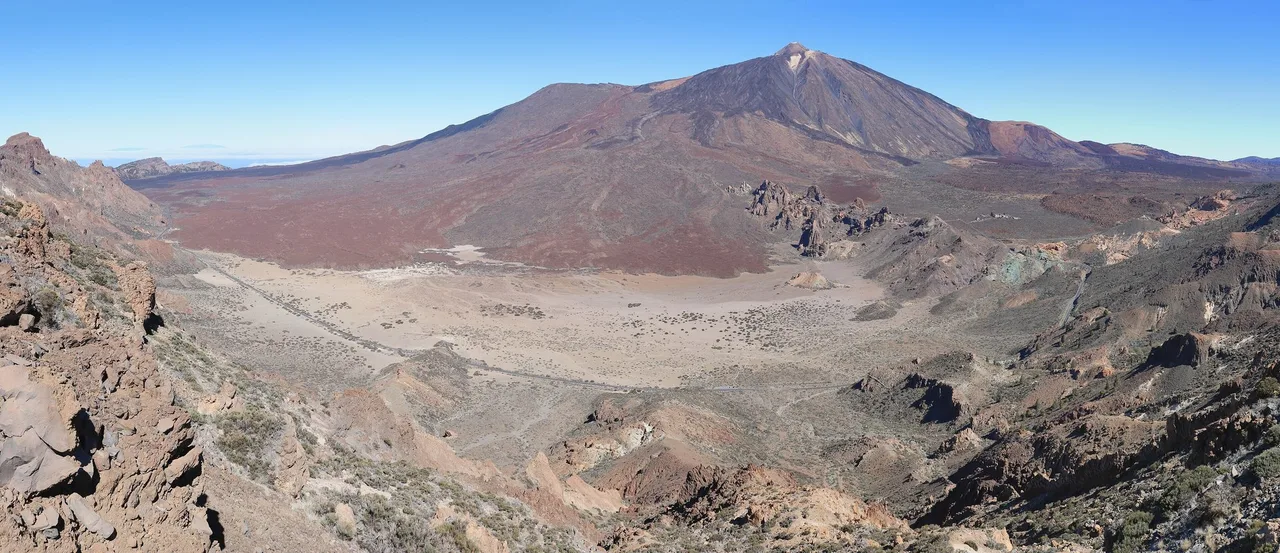
That has a direct link to high-mountain trips. Tenerife's Teide National Park, for example, allows sleeping outdoors without a tent only in four designated bivouac zones with prior authorisation. Exposed volcanic ground at altitude is cold ground in the full sense, so an insulating pad is not an optional extra there. We describe the permits in our Teide guide.
What to weigh against the R-value
Weight and pack size: air pads usually win, closed-cell foam is the bulky end. Weigh them in your own hands in a shop, in grams, and check the packed dimensions against your pack.
Durability and repair: foam cannot puncture. Air pads and self-inflating pads can. If you choose one, carry the maker's repair kit, and test the pad at home before a trip by inflating it and leaving it overnight.
Noise and feel: some air pads rustle when you move and some feel like a bouncy castle. If you sleep lightly, lie on a display model before buying.
Width and length: a pad that is too narrow lets elbows touch the ground, which is exactly where you lose heat. Check the dimensions for your shoulders and height.
Inflation: most pads inflate by mouth, with a pump sack or a small pump. Follow the instructions of the maker, since some warn about moisture inside the pad.
Cost: prices range widely. Spend where it counts, on R-value that suits your coldest planned night and on a pad you will actually sleep on.
A quick way to decide
- Hut to hut in summer with bunks provided: you probably do not need a pad at all.
- Summer camping on soft ground at low altitude: a lightweight air or self-inflating pad with a modest R-value, or a simple foam pad if weight and puncture risk worry you.
- Shoulder season, autumn or spring, with cold nights: step up the R-value, and consider stacking a thin foam pad under an air pad.
- High mountain, rock, or snow: choose the highest R-value you can carry, and consider a foam pad as insurance against a puncture.
Common mistakes
- Choosing by thickness alone. A thick uninsulated air pad can feel soft and still leave you cold.
- Mixing scales when comparing R-values.
- Never testing the pad at home. A slow leak found at 2,000 m is no fun.
- Ignoring the ground. Granite slabs and cold meadow need different amounts of insulation.
- Forgetting that the pad has to match your bag, not fight it.
Sources and verification date
Checked on 16 October 2026: the open encyclopedia entries on sleeping pads and on R-value (insulation), and the scope of ASTM F3340-18, the standard test method for the thermal resistance of camping mattresses. The bivouac rules in Teide National Park come from Tenerife ON. The illustrations are our own and are simplified.