Battery decides this one
On a mountain trip the number that matters most is rarely the screen size or the list of sports. It is how many days the watch will keep recording a track after you leave the last socket behind. Garmin's outdoor range answers that question in very different ways, from a 249.99 USD button-only watch to a 1,299.99 USD titanium model with satellite messaging. This guide lines them up for hikers, mountain walkers and multi-day trekkers.
Every figure comes from Garmin's own specification pages and press releases, read on 2026-10-16 (Garmin.com, checked 2026-10-16). Our advice is a reading of those numbers and the usual realities of walking in the mountains.
Quick picks
List prices are from Garmin's US store (USD) and its Irish store (EUR, en-IE) on 2026-10-16. They differ between countries, tax is handled differently, and they change. Garmin sells most of these in several case sizes and materials, so we show the lowest listed price for the model named. We link to no shops.
| Best for | Model | USD | EUR |
|---|---|---|---|
| Day hikes on a budget | Instinct E (40 / 45 mm) | 249.99 | 249.99 |
| Day hikes with colour, multi-band GPS, buttons | Instinct 3 AMOLED (45 / 50 mm) | 349.99 / 399.99 | 349.99 / 399.99 |
| Weeks between charges, simple screen | Instinct 3 Solar (45 / 50 mm) | 349.99 / 399.99 | 349.99 / 399.99 |
| Analogue hands plus digital screen | Instinct Crossover (standard / solar / AMOLED) | 399.99 / 449.99 / 649.99 | 399.99 / 449.99 / 599.99 |
| Maps without the flagship price | fēnix E (47 mm) | 799.99 | 599.99 |
| Previous-generation maps and touchscreen | fēnix 8 (43 / 47 / 51 mm) | 999.99 / 999.99 / 1,099.99 | 799.99 / 799.99 / 899.99 |
| Current all-round mountain watch | fēnix 9 (43 / 47 / 51 mm) | 999.99 / 999.99 / 1,099.99 | 999.99 / 999.99 / 1,099.99 |
| Titanium case, lighter, solar options | fēnix 9 Pro (43 / 47 / 51 mm) | 1,099.99 / 1,099.99 / 1,199.99 | 1,099.99 / 1,099.99 / 1,199.99 |
| Messaging and SOS without a phone | fēnix 9 Pro with inReach (43 / 47 / 51 mm) | 1,199.99 / 1,199.99 / 1,299.99 | 1,199.99 / 1,199.99 / 1,299.99 |
| Longest battery with solar | Enduro 4 (51 mm) | 899.99 | 899.99 |
fēnix 8 Pro, with prices from 1,099.99 USD, and the tactical tactix 8 are also sold. We cover fēnix 8 Pro briefly below and leave tactix aside.
Who each family is for
Instinct E, Instinct 3 and Instinct Crossover
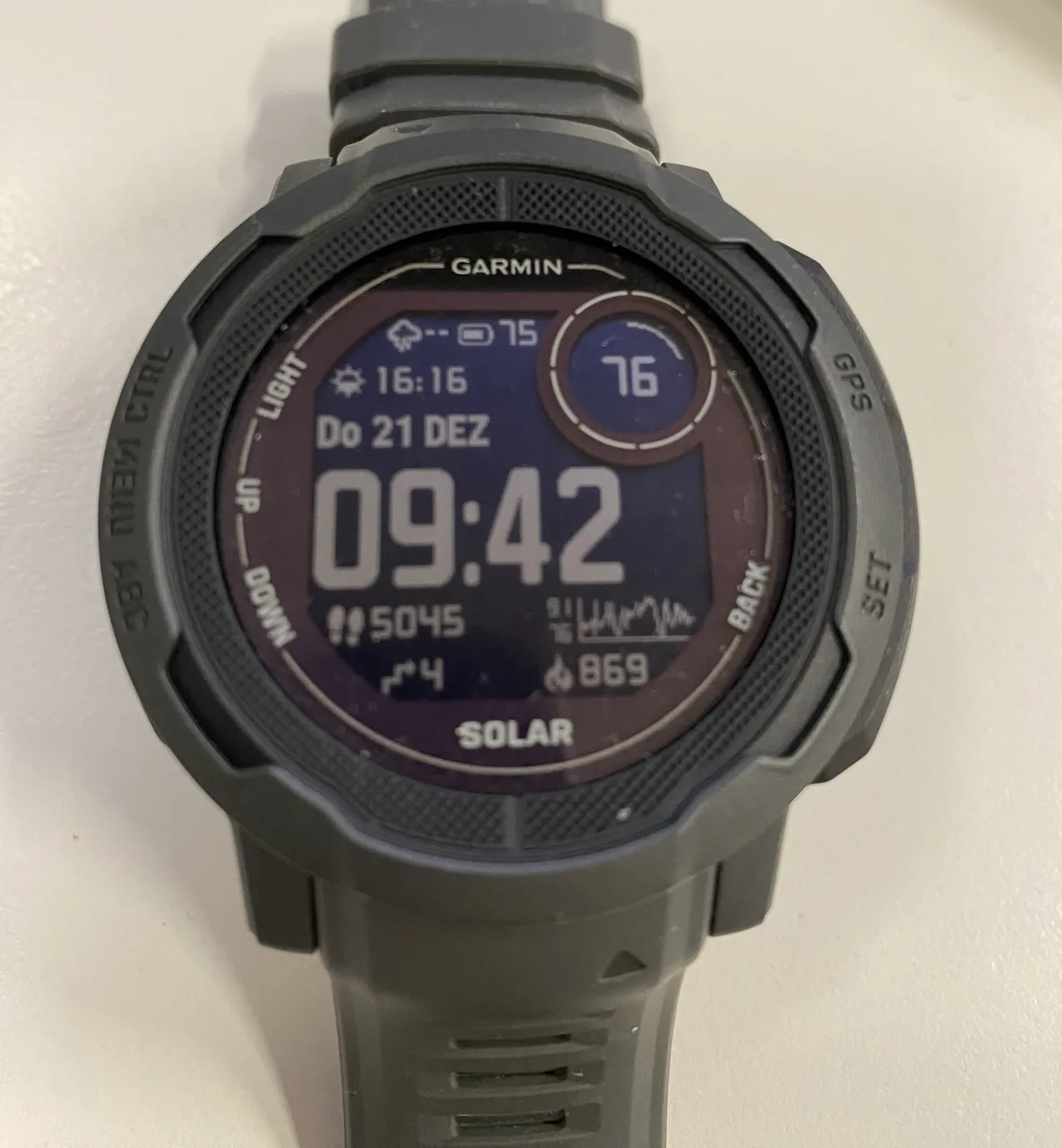
Instinct is Garmin's hard-wearing, button-operated line. All of the models above list 10 ATM water resistance, a barometric altimeter, a compass and a breadcrumb trail with TracBack and course guidance. None lists a touchscreen or built-in maps, and storage is small: 128 MB or less on the monochrome models and 4 GB on AMOLED ones.
Instinct E is the plain version: monochrome display, no multi-band GPS, no flashlight and no training readiness on its spec page. It weighs 41 g (40 mm) or 48 g (45 mm). Instinct 3 AMOLED adds multi-band GPS, an LED flashlight and training readiness, at 53 g (45 mm) or 59 g (50 mm). Instinct 3 Solar keeps a monochrome screen and adds a solar lens, at 52 g (45 mm) or 58 g (50 mm). Instinct Crossover mixes analogue hands with a digital display and weighs 65 to 67 g.
fēnix E
fēnix E is the entry to Garmin's mapping watches: a 1.3-inch AMOLED touchscreen in a 47 mm case, 16 GB of storage, downloadable maps, music storage and ClimbPro ascent planner. It has no multi-band GPS and no flashlight on its spec page. It lists up to 16 days in smartwatch mode and up to 42 hours of GPS-only tracking.
fēnix 8 and fēnix 8 Pro
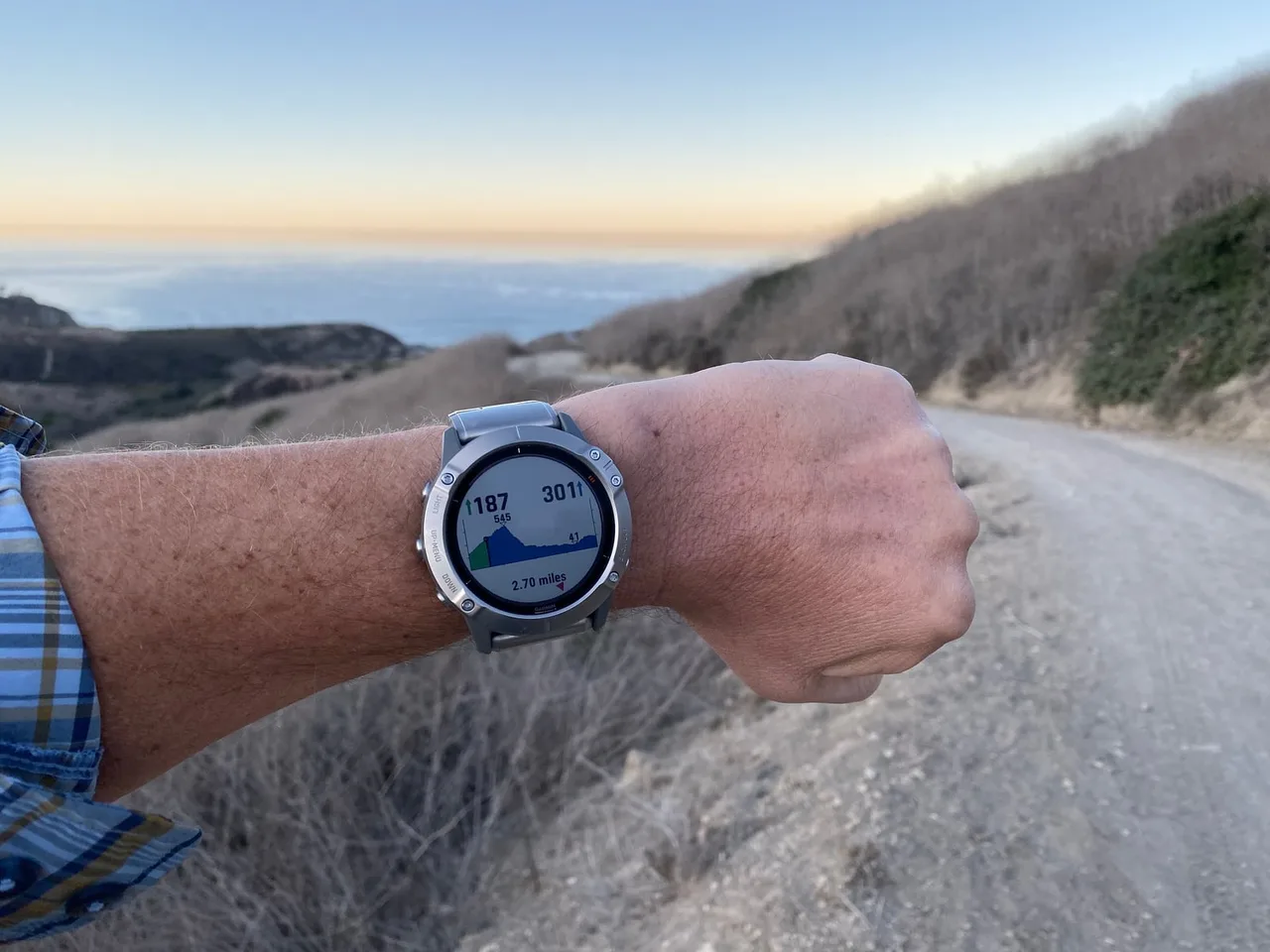
fēnix 8 comes as AMOLED in 43, 47 and 51 mm and as solar in 47 and 51 mm, with built-in maps, multi-band GPS, a flashlight and 32 GB of storage. The 51 mm AMOLED lists up to 29 days in smartwatch mode. fēnix 8 Pro is the step above, and its spec page lists satellite and LTE messaging that needs an active inReach plan.
fēnix 9 and fēnix 9 Pro
Announced on 25 August 2026, fēnix 9 keeps the fēnix 8 formula and raises storage to 64 GB. Garmin's release also mentions a brighter AMOLED display, a faster map engine and a feature called Garmin Epic, which groups several days of activities into one story. The 51 mm model lists up to 29 days in smartwatch mode.
fēnix 9 Pro uses a titanium case and adds options. AMOLED versions list up to 3,000 nits of brightness; solar versions use a transflective, sunlight-readable display. The 51 mm AMOLED lists up to 31 days in smartwatch mode. inReach versions in all three sizes add satellite and LTE messaging and SOS, but they need an active plan, LTE coverage is not available everywhere, and Garmin's footnotes state that satellite and SOS functions have limits compared with its dedicated inReach devices.
Enduro 4
Enduro 4 is built for endurance: a 1.4-inch memory-in-pixel display, a solar lens, a 66 g weight listed by Garmin and 64 GB of storage. It lists up to 36 days in smartwatch mode (90 days with solar) and, in extended-battery activity mode with solar, up to 320 hours. It has built-in maps, multi-band GPS, an LED flashlight with white and red light, and a titanium bezel with a sapphire lens.
Battery in numbers
Garmin states figures as "up to" values for specific modes, so only compare like with like. The solar numbers assume Garmin's stated conditions: all-day wear with three hours a day outdoors in 50,000 lux for smartwatch mode, or continuous use in 50,000 lux for activity modes. A day in a forest, under sleeves or in winter cloud will not match that.
| Model | Smartwatch mode | GPS-based tracking | Expedition mode |
|---|---|---|---|
| Instinct E 45 mm | 16 days | 24 h GPS | 20 days |
| Instinct 3 AMOLED 50 mm | 24 days | 40 h GPS | 20 days |
| Instinct 3 Solar 50 mm | 40 days, unlimited with solar | 60 h GPS, 260 h with solar | 60 days, unlimited with solar |
| fēnix E 47 mm | 16 days | 42 h GPS | 14 days |
| fēnix 9 47 mm | 16 days | 30 h activity | 18 days |
| fēnix 9 51 mm | 29 days | 54 h activity | 31 days |
| fēnix 9 Pro 51 mm AMOLED | 31 days | 56 h activity | 31 days |
| fēnix 9 Pro Solar 51 mm | 30 days, 57 with solar | 75 h activity, 124 h with solar | 42 days, 124 with solar |
| Enduro 4 | 36 days, 90 with solar | 80 h activity, 144 h with solar | 77 days, unlimited with solar |
Garmin uses "GPS" wording on some pages and "activity mode (normal)" on others, so the middle column is not a perfect match across generations. Max-battery modes go much further: Garmin lists up to 151 hours for the fēnix 9 Pro 51 mm AMOLED and up to 210 hours for the Enduro 4 without solar, at the cost of accuracy and features.
Planning around days, not hours
For a multi-day route, convert the figures into your own trip. Say you walk eight hours a day with the track on for five days: that is 40 hours of recording. Against Garmin's GPS-style figures, an Instinct E 45 mm (24 hours) needs a charge or a power-saving mode partway through, an Instinct 3 AMOLED 50 mm (40 hours) is right at the limit, a fēnix 9 51 mm (54 hours of normal activity mode) clears it with a little margin, and the Enduro 4 (80 hours, or 144 with solar) has room to spare. Switching to a lower-power mode stretches every one of these figures, but also changes how often the position is logged, so the track becomes coarser.
Two other habits stretch the numbers: turning off the always-on display and keeping music and phone notifications off in the field. The low-power watch modes on fēnix and Enduro, and the expedition modes on all of them, are designed for exactly this. Garmin lists, for example, up to 31 days of expedition mode for the fēnix 9 Pro 51 mm AMOLED, and up to 77 days for Enduro 4 without solar.
Cold and altitude change the picture. Most lithium-ion batteries lose capacity in the cold, and a watch worn under a jacket cuff gets almost no solar input. Plan on the lower end of Garmin's numbers in winter, carry a small power bank and the right cable for your model, and charge the night before you leave.
Maps, routes and screens
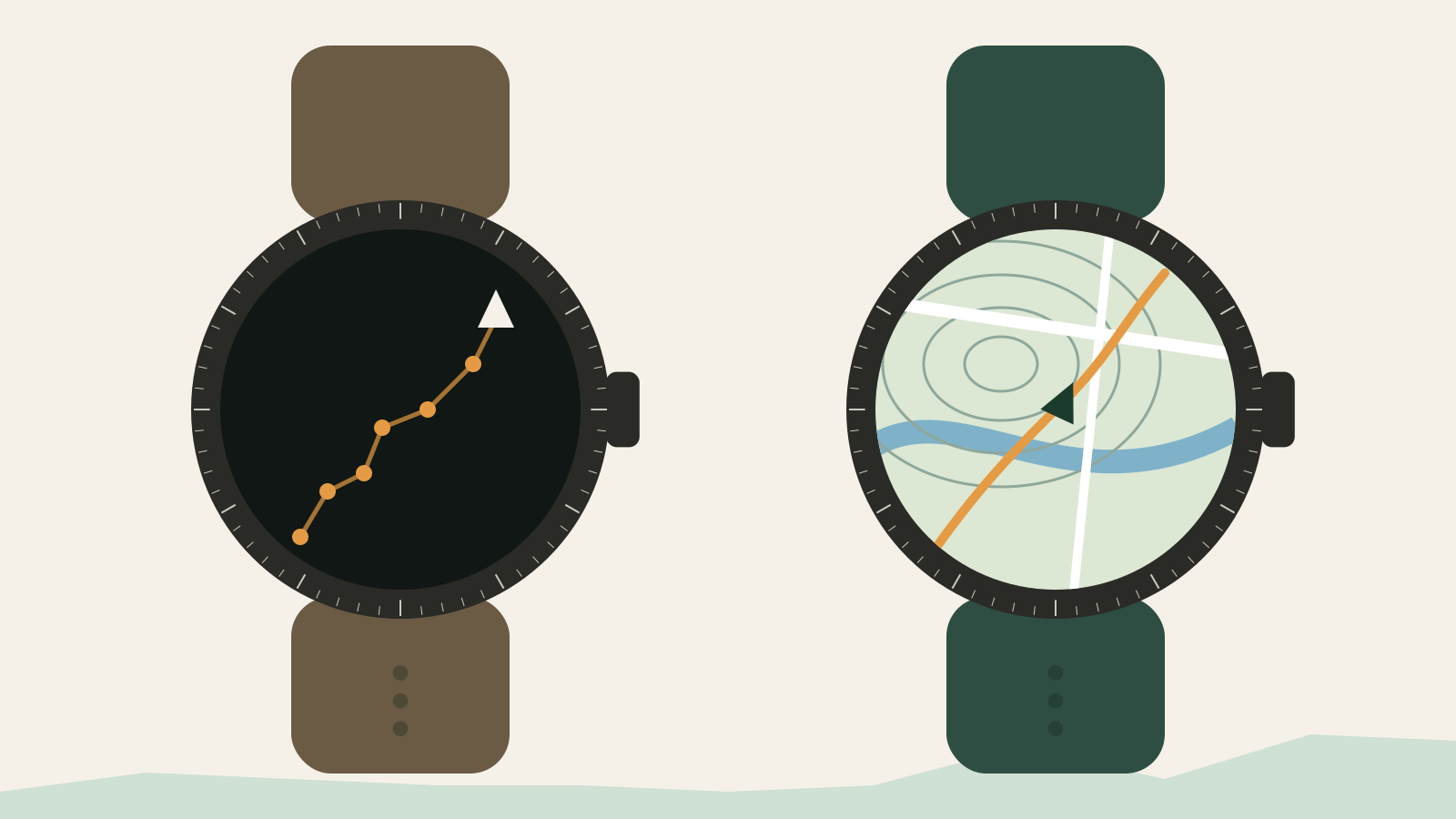
Instinct watches show where you have been and can lead you back along that line. fēnix and Enduro watches show a map: preloaded road and trail maps, ski-resort maps, a full vector map, a ClimbPro ascent planner, NextFork turn guidance and an "Up Ahead" view of what comes next on a course. For marked paths in familiar country, a breadcrumb line is often enough. For junctions in fog, a map is easier to trust, though still a backup to a paper map or a phone.
Screens come down to a choice. AMOLED is sharper and brighter and is touch-operated on fēnix; the cost is battery. Memory-in-pixel (MIP) screens are less colourful but readable in sun and sip power.
What each price step buys
At the bottom, the Instinct E costs 249.99 USD. Moving to the 45 mm Instinct 3 AMOLED costs 100 USD more and brings an AMOLED screen, multi-band GPS, an LED flashlight and training readiness on the spec page. The solar Instinct 3 has the same 349.99 USD price in the 45 mm size and swaps the screen for much longer battery life.
The jump to a mapping watch is larger. fēnix E, at 799.99 USD, is about 450 USD above the Instinct 3 AMOLED 45 mm. For that you get a touchscreen, downloadable maps, 16 GB of storage and a more detailed navigation toolset, but not multi-band GPS. From fēnix E to the 47 mm fēnix 9 is 200 USD, and multi-band GPS, a flashlight, the ECG app and 64 GB of storage appear on the spec page. The Pro line costs 100 USD more in the 47 mm size and adds a titanium case; solar and inReach versions are Pro options.
Enduro 4, at 899.99 USD, is listed 100 USD below the 47 mm fēnix 9 and ahead of every watch here on battery. The trade is the screen: memory-in-pixel instead of AMOLED, which is less colourful but easier on the battery.
Size, weight and wrists
Weights run from 41 g (Instinct E 40 mm) to 102 g (fēnix 9 Pro Solar 51 mm). For overnight trips, a lighter case matters less than the battery, but a 100 g watch on a thin wrist gets noticed at the end of a day. fēnix 9 and 9 Pro come in a 43 mm size with a stated wrist range of 108 to 182 mm, which opens this class to smaller wrists.
Buttons, touch and gloves
Instinct watches are operated by buttons only, which is easier with gloves or wet fingers. The fēnix and Enduro watches list a touchscreen, and the fēnix 9 spec page also lists a touch and button lock, so you can use the buttons and switch the screen off for rain or a backpack strap. That is a usable mix, but it is worth trying a model in a shop with the gloves you actually wear.
Honest limits
- A watch is a backup, not a navigation plan. Carry a map, know your route and keep a phone charged.
- Barometric altimeters drift with weather. The pressure-trend and storm alert on these watches is a trend indicator, not a forecast.
- Cold reduces lithium-ion battery output in general, so the lower end of Garmin's range is a safer assumption in winter.
- Solar helps most in open, bright terrain and little in forest, in winter or under cuffs.
- inReach needs an active plan, which has its own cost. Check Garmin's requirements and coverage for the regions you visit before relying on it.
- Heart rate, SpO2 and acclimation figures are wellness indicators. Garmin states that its health features are not medical devices. Do not use them to decide whether you are fit to ascend.
How we chose
We used only models listed on Garmin's adventure and smartwatch pages on the US store and the Irish store on 2026-10-16: Instinct, fēnix and Enduro. Specifications, list prices and launch details come from Garmin's own pages and press releases, not from reviews or retailers. We did not use Garmin's own press photographs, shop links or affiliate links. The photographs come from Wikimedia Commons under free licences, and each caption names the exact model shown. Free photos of the current models do not exist, so these two show earlier generations and say so. The other illustrations are our own drawings. Left out on purpose: tactix 8 (tactical features), MARQ (luxury watches, with a third generation announced on 13 October 2026), Approach (golf) and the CIRQA Smart Band, which has no display.
Common questions
Is solar worth the extra? On the Instinct 3 the solar 50 mm costs the same as the AMOLED 50 mm and trades screen quality for much longer battery. On fēnix 9 Pro the solar 47 mm costs the same as the standard one. Check whether you can live with the less colourful display.
Do I need maps on my wrist? Not for marked trails in familiar areas. They help most where trails branch, in poor visibility and on multi-day routes you downloaded in advance.
Is the inReach version worth the step up? It costs 100 USD or EUR more than the matching Pro model in 43, 47 and 51 mm, plus a separate plan. It matters mainly if you walk in places without mobile coverage and want to message or call for help without carrying another device.
fēnix 9 or fēnix 8? Both list the same battery on the 51 mm AMOLED (29 days). fēnix 9 lists 64 GB of storage against 32 GB, and the fēnix 8 has lower entry prices in the Irish store.
Sources and verification
Garmin.com, checked 2026-10-16: product specification pages on the US store (en-US) and the Irish store (en-IE); Garmin newsroom releases for fēnix 9 and fēnix 9 Pro (25 August 2026) and Enduro 4 (6 October 2026). Specifications and prices can change after this date. We link to no shops.
Related reading
For running and everyday sport, see Which Garmin watch for running and everyday sport.